

Quick Take: Iraq’s Oil Ministry says exploratory drilling in the Qurnain Block — a desert concession in Najaf province, on the Saudi border — has confirmed roughly 8.8 billion barrels of recoverable light crude. The operator is China’s ZhenHua Oil. The find arrives in week eleven of a Strait of Hormuz shutdown that has pushed Brent above $100, dragged US gas prices past $4 a gallon, and turned a few American energy names into the best-performing stocks of 2026. Here’s what it actually means for your gas tank, your portfolio, and the next move in the Iran crisis.
What Was Just Discovered?
Iraqi Oil Minister Hayyan Abdul Ghani confirmed the find on May 7. The Qurnain Block covers 8,773 square kilometers of underdeveloped desert in southern Iraq, right against the Saudi border. The exploratory well — known in the field as Shams-11 — was drilled to roughly 1,900 meters and tested at about 3,248 barrels per day of light crude.
That flow rate, on its own, is modest. The number that matters is the resource estimate: roughly 8.8 billion barrels of light crude in place, one of the most significant Iraqi discoveries of the last decade.
The operator is Qurnain Petroleum Limited, controlled by China’s state-backed ZhenHua Oil. ZhenHua won the concession in Iraq’s late-2024 licensing round and has now greenlit an accelerated investment plan, meaning commercial production could ramp years sooner than a normal frontier project would allow.
Why It Matters Now — With Iran on the Brink
The timing is the story. The Strait of Hormuz — the chokepoint that historically carries roughly a fifth of global seaborne oil — has been effectively shut since late February, when fighting between US-aligned forces and Iran escalated. President Trump’s “Project Freedom” naval escort effort is paused while Washington and Tehran try to negotiate a permanent ceasefire that repeatedly threatens to fall apart.
For Iraq, which historically routed more than 94% of its exports through Hormuz, the closure has been brutal. Baghdad’s crude revenue collapsed from $6.81 billion in February to roughly $1.96 billion in March, as monthly export volumes dropped from 99 million to 18.6 million barrels.
That is why Baghdad isn’t only celebrating a barrel count. It is racing to build the Basra–Haditha pipeline — a 2.5 million barrel-a-day project meant to send crude west, toward Mediterranean terminals at Turkey’s Ceyhan and Syria’s Baniyas. Together with the partially revived Kirkuk–Ceyhan line — currently pumping just 200,000 to 250,000 barrels a day — those pipes are now the only way Iraqi crude reaches Western buyers.
In short: the discovery alone changes nothing this week. The pipelines change everything in twelve months.
How Much Could It Move Crude Prices?
Short-term, very little. Brent was trading near $100 a barrel on Friday after touching $114 at the peak of the crisis in early May. WTI closed around $95. The market is moving on Iran ceasefire headlines, not Iraqi reserve announcements.
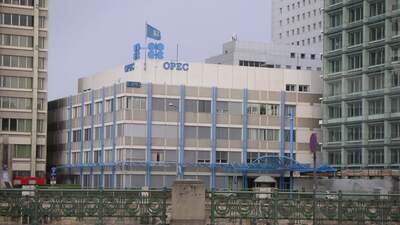
Medium-term, the find does matter. Iraq already holds 145 billion barrels of proved reserves — about 8% of the world’s total — and is OPEC’s second-largest producer after Saudi Arabia. Add another 8.8 billion barrels and a Chinese partner willing to spend, and you have a plausible new supply story for the back half of the decade — exactly the period in which Wall Street has spent the past eighteen months pricing a structural deficit.
If a US–Iran deal eventually reopens Hormuz and Iraq’s new pipelines come online together, the global market has more spare capacity than current pricing suggests. That is one reason the IEA and several Wall Street desks have argued recent levels look like a “war premium,” not a new equilibrium.
Which US Energy Stocks Stand to Benefit?
For now, the trade is still long crude. As of last week, Occidental Petroleum (OXY) is up roughly 35% year-to-date, EOG Resources (EOG) about 29%, and ConocoPhillips (COP) around 27% — the cleanest exploration-and-production plays on a higher WTI strip. Supermajors ExxonMobil (XOM) and Chevron (CVX) have lagged the rally, sticking to capital discipline; TD Cowen last week reiterated a $172 price target on XOM despite a Q1 earnings dip tied to refining losses.
A more contrarian read: if Qurnain accelerates a post-crisis supply-glut narrative, today’s winners become tomorrow’s laggards. Investors looking for diversified exposure can rotate into broad oil ETFs — see our coverage of the best ETFs to invest in oil — instead of single-name bets.
The defense-and-energy basket Wall Street watched at Monday’s open after the 72-hour Russia–Ukraine truce remains the cleanest playbook for the next ceasefire headline: tight stops, defined levels, and an exit if Brent slips back under $90.
The Bottom Line
For the American driver, Qurnain does nothing for the price at the pump this Memorial Day weekend. For the American investor, it’s a reminder that markets have spent the past two months hitting record highs with a war in the Persian Gulf — and that the next leg of the oil trade may hinge less on what Iran does than on whether Iraq can finally move its crude past Hormuz.
This article is adapted from the Italian original by Money.it. Read the source here. Sources: Iraqi Ministry of Oil press statement (May 7, 2026); US Energy Information Administration country brief on Iraq; Reuters, Bloomberg and CNBC reporting on Brent and WTI prices, US gas prices and energy-sector performance (May 5–11, 2026); IEA crude supply briefing on the Hormuz shutdown.