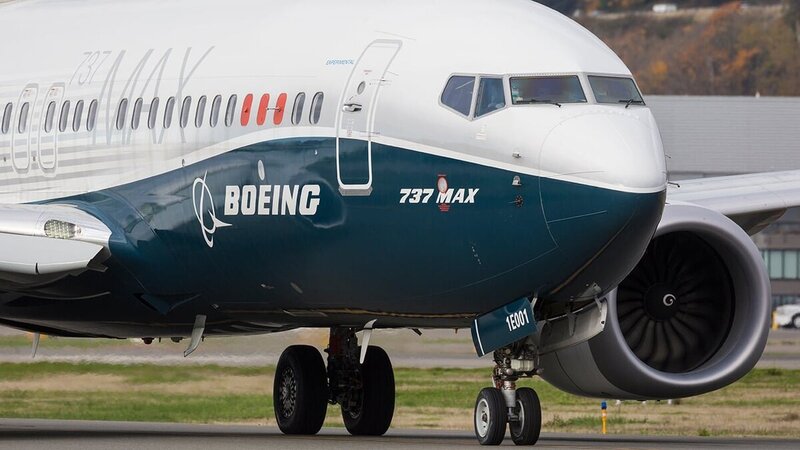
Air Force One left Beijing on Friday with handshakes, a state-dinner toast, photographs of two heads of state in matching dark suits, and a polite Chinese pledge to buy 200 Boeing aircraft. The number sounds large. It is, in fact, only fifty more than Boeing’s own previous expectation of 150, and well short of the up to 500 jets that Jefferies and several other Wall Street desks had been calling for in their pre-summit notes. Boeing shares fell almost 5% on Thursday on the disappointment, then extended losses on Friday. The trip did not leave with a trade deal. Wall Street, which had been pricing one in for weeks, did not leave with one either. And that, in the end, is the only sentence about the trip that matters for the next twelve months of market pricing.
For six months, the rally that pushed the S&P 500 above 7,500 for the first time in history rested on a single load-bearing premise: that the Trump-Xi summit would deliver something concrete. A tariff schedule. A rare-earth corridor. A fentanyl-precursor crackdown with teeth. A carve-out on AI chip exports. An investment framework. Anything, really. By the time the press plane lifted off Beijing Capital, the only signed-and-delivered item was Boeing’s order. The rest was ceremony.
The numbers do not flatter the trip. The $10 billion-a-year commitment on US agricultural purchases, spread across three years, totals $30 billion — roughly one-tenth of the $295 billion US goods deficit with China in 2024 alone. The 200 Boeing jets, even priced as if they were all 737 MAX deliveries at full list, work out to a headline number in the $25-30 billion range, again the same one-tenth-of-the-gap order of magnitude. And once you net out the 150 Boeing already expected to sell, the genuinely new Chinese commitment is closer to fifty incremental planes than two hundred. On Taiwan, the US position is, in Secretary Marco Rubio’s own words after the summit, “unchanged.” On rare earths, nothing. On AI, nothing. On the fentanyl flow that is the actual subject of bipartisan US anger, both sides “pledged to work toward” ending precursor exports — which is the diplomatic register for not having agreed to anything.
The chicken’s data was excellent
The defenders of the trip will say that ceremony has its own value. That “stabilization” in the world’s most dangerous bilateral relationship is itself a kind of deal in an era of cold-war drift. That the absence of escalation — no new tariffs, no rare-earth retaliation, no Taiwan ultimatum, no breakdown of the South Korea-side trade truce — is itself a market-positive outcome. All of that is true. And none of it is what the rally has been priced for. The rally was priced for the arrival of good news, not for the absence of bad news. The difference, in equity-multiple terms, is a few hundred basis points.
Bertrand Russell once made the same point with a chicken. Every morning, at the same hour, the farmer fills the trough. From the chicken’s perspective, the laws of nature are clear: same hand, same hour, same grain. The data accumulates. The inductive case grows airtight — until the morning the farmer arrives with a knife instead of a feed bucket. Nassim Taleb borrowed the same image for the turkey on Thanksgiving eve. Wall Street, fed weekly for six months by the “China deal coming” narrative, had drawn precisely that induction. Friday’s open was the first morning the grain did not arrive. The interesting question is not whether the chicken survives — it is what the chicken does next.
Look beneath the index level and the picture is harder. Earlier this week, the Schwab desk, citing Bloomberg, flagged that the S&P 500’s market internals are now showing the same combination of features last seen in late 2021, shortly before the bear market: a record surge in single-stock gamma, stock correlation at multi-year lows, extreme dispersion, and heavy concentrated call buying in a handful of semiconductor names. Each of those features in isolation is benign. Together they are the textbook description of a market that has stopped pricing risk. They are also the textbook description of the late stage of any speculative cycle.
Powell exits on records, Warsh inherits the bill
All of this lands on Friday — the day Jerome Powell’s eight-year tenure as Fed chair officially ends and Kevin Warsh prepares to take over. Warsh was picked by President Trump for one reason: to cut rates. Then April’s Consumer Price Index printed at 3.8% year-over-year, the hottest reading since May 2023. The Producer Price Index followed at 6.0% on the year, the largest annual print since April 2022, according to the Bureau of Labor Statistics. Futures markets are now pricing roughly a 3% chance of any rate cut in 2026 and a 36% chance of a hike, per the CME FedWatch Tool. Warsh’s inbox, by Monday morning, contains in order: an inflation problem he cannot wish away, a Fed-Treasury balance-sheet negotiation his predecessor parked, a 10-year Treasury yield hovering around 4.45% and staring at 4.50%, and an equity market trading at the priciest forward-earnings multiples since 2021. The new chair’s first job, in other words, is to disappoint the man who picked him.
The morning the grain does not arrive
Powell ended his term on records. The political reading is triumphalist: an S&P above 7,500, a Dow back above 50,000, a tape that has rewarded patience for nearly two years without a real correction. The financial reading is harder. Those records were built on a rate path that has been on hold for over a year, an oil-price floor that the Persian Gulf has now welded into headline CPI, and a single foreign-policy hope — the China breakthrough — that has just ended in a state dinner. The chicken’s data was excellent. The chicken’s data is always excellent. The question Wall Street will spend the weekend trying to answer is not whether the rally can hold one more week. It is what a market priced for breakthroughs is worth on the morning the breakthrough does not come.
[1]