

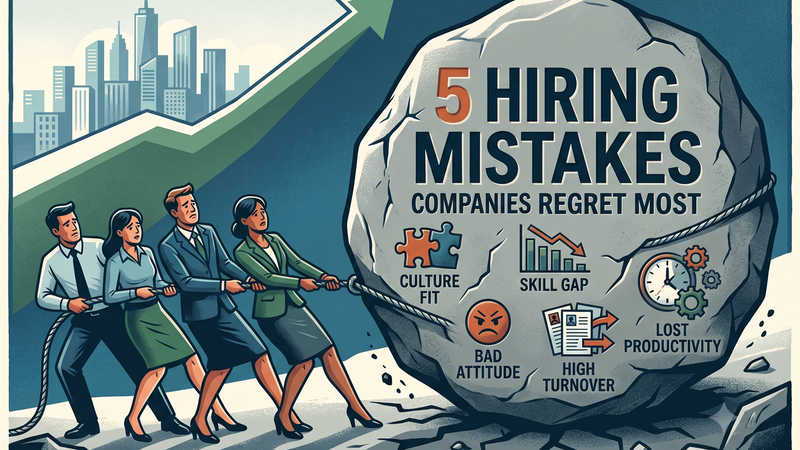
Companies rarely regret hiring someone who was obviously wrong from the beginning. The most expensive hiring mistakes usually start with candidates who look convincing: strong CVs, confident interviews, relevant experience, polished references and the right language for the role. The problem is that interviews often measure presentation better than execution.
To understand which hiring decisions companies regret most, Money.it gathered direct insights from founders, CEOs and managers who have seen promising hires turn into operational problems.
1. The impressive CV that fails under pressure
One of the most common regrets is hiring someone who looks excellent in a controlled interview but struggles when the real work becomes messy.
Mike Walker, Co-founder and Managing Director of MGN Events, a UK creative events agency, says this is particularly visible in events, where pressure is part of the job. In his words, “the hire we regret most is almost always the impressive CV that cannot cope when the room gets difficult.”
The warning sign, he explains, is not always a lack of experience. It can be the opposite: too much confidence and too little evidence of accountability. “We have been caught out by people who interviewed brilliantly and then went quiet the moment real pressure arrived,” Walker says. Looking back, the missed signal was “over confidence and never once mentioning a mistake they owned.”
For roles exposed to clients, suppliers, deadlines or operational stress, the lesson is clear: companies should not only ask what a candidate achieved, but what happened when a project went wrong and what they personally did about it.
2. The smart talker who cannot deliver
A similar hiring mistake happens when companies confuse communication with performance.
David Fesman, President and Owner of MedMart, a Cincinnati-based medical equipment company, describes this as one of the most repeated hiring regrets after two decades of experience. “The worst hire is the smart-talker who didn’t deliver at the job,” he says.
In one case, MedMart hired a sales representative who interviewed extremely well. The candidate was “warm, articulate” and appeared to understand the company’s customers. But after 60 days, the gap became clear. “It was not the skill that was in the room but the work,” Fesman says.
The mistake was relying too much on personality and too little on evidence of past execution. Fesman says the company later shifted its approach: “History of performance in a similar task better than potential in the same task.” In practical terms, this means asking candidates about real past situations, not just future intentions.
3. The urgent hire made because the business is growing
Fast-growing companies often make their worst hiring decisions when the need feels urgent. A vacancy opens, demand is rising and the team is under pressure. The temptation is to fill the role quickly and deal with the consequences later.
Dmitrii Malashkin, Founder and CEO of Born to Move, a multi-city moving company operating across US markets, says the biggest mistake is “to wait until the hiring need is urgent and painfully obvious.”
He recalls a rushed hire in the Chicago branch after a key crew member suddenly disappeared. On paper, the candidate looked strong: good recommendations and a perfect logistics quiz score. But the red flags were already present. When asked about high-pressure situations, the candidate gave what Malashkin describes as a “safe” and “generic” answer, while also blaming previous employers for dissatisfaction and turnover.
Within three months, the hire created serious operational damage: morale fell, turnover in the branch rose and the company calculated a $36,000 cost in lost revenue, fixes, hiring and training a replacement. The lesson was not simply to be more careful, but to change the timing of hiring. Born to Move now hires based on a three-month revenue forecast instead of reacting to sudden gaps. As Malashkin puts it, “the best hires are those made for tomorrow, not today.”
4. The candidate who blames every failure on others
Another hiring regret appears when companies mistake interview performance for operational performance, especially in roles exposed to change, ambiguity and moving priorities.
Eliot Vancil, CEO of Fuel Logic, a US fuel management company, says the worst hire is often “the candidate that has a great interview but struggles when change occurs.” In his view, there is a clear difference between “skills measured by interview performance and skills measured by operational performance.”
The problem, he explains, is that good communicators can look strong in a structured conversation but become paralysed when schedules change, vendor networks break down or operational pressure increases. “The thing that cost me the most is assuming that there would be a correlation between communication and execution,” Vancil says.
He also points to another warning sign companies often overlook: candidates who blame every past failure on previous employers, teams or external constraints. “If the candidate blames all previous failures on a previous employer, then he/she will behave the same way in the future,” he says.
For companies hiring into operational roles, the lesson is not to dismiss communication skills, but to test whether communication is matched by execution, ownership and the ability to adapt when things stop going according to plan.
5. The technically strong hire who cannot work with people
Hiring for technical expertise while neglecting collaboration is another recurring mistake.
Yad Senapathy, Founder and CEO of the Project Management Training Institute, a US-based project management training provider, says companies often regret selecting candidates “based on technical skills instead of their ability to work well with others.”
He cites the example of a project lead with an impressive resume who was unable to keep the team together for more than three weeks. The company had verified the technical side of the role, but failed to assess the interpersonal one. In Senapathy’s words, “the company had checked the technical box but failed to check the people box.”
The warning signs are often visible in how candidates describe previous failures. Senapathy argues that candidates who consistently blame teams, budgets or external constraints may be revealing how they will behave under pressure. One hiring manager, he says, initially interpreted that kind of answer as honesty, but later realised “the candidate had, in fact, been passing blame.”
For leadership and project roles, this matters because technical knowledge alone is not enough. The hire also needs judgment, accountability and the ability to keep people aligned when priorities change.
What these hiring regrets have in common
The worst hiring decisions are not always about hiring unqualified people. More often, they come from believing the wrong signal.
A strong CV does not guarantee resilience. A confident interview does not guarantee execution. A senior title does not guarantee hands-on capability. Technical skill does not guarantee collaboration. And hiring quickly does not necessarily solve an urgent problem; sometimes it creates a larger one.
Across the experiences shared by founders and managers, the same practical lessons emerge. Companies should test candidates under conditions that resemble the real job. They should ask about failures, not only successes. They should look for ownership, not just polish. They should check how people behave when structure is limited, pressure is high or feedback is difficult. And they should avoid letting urgency lower the standard.
The best hiring processes do not only ask whether a candidate can do the job in theory. They ask whether that person can succeed in this company, at this stage, with this level of ambiguity, pressure and responsibility.
That is where many hiring regrets begin: not in the candidate’s lack of ability, but in the company’s failure to test the ability that actually mattered.